Medical Providers · Practical Growth Guide
How to Attract New Patients to Your Medical Practice: A Practical Growth Plan
Build a patient acquisition plan around service priorities, local discovery, clear website information, scheduling, and completed first appointments.
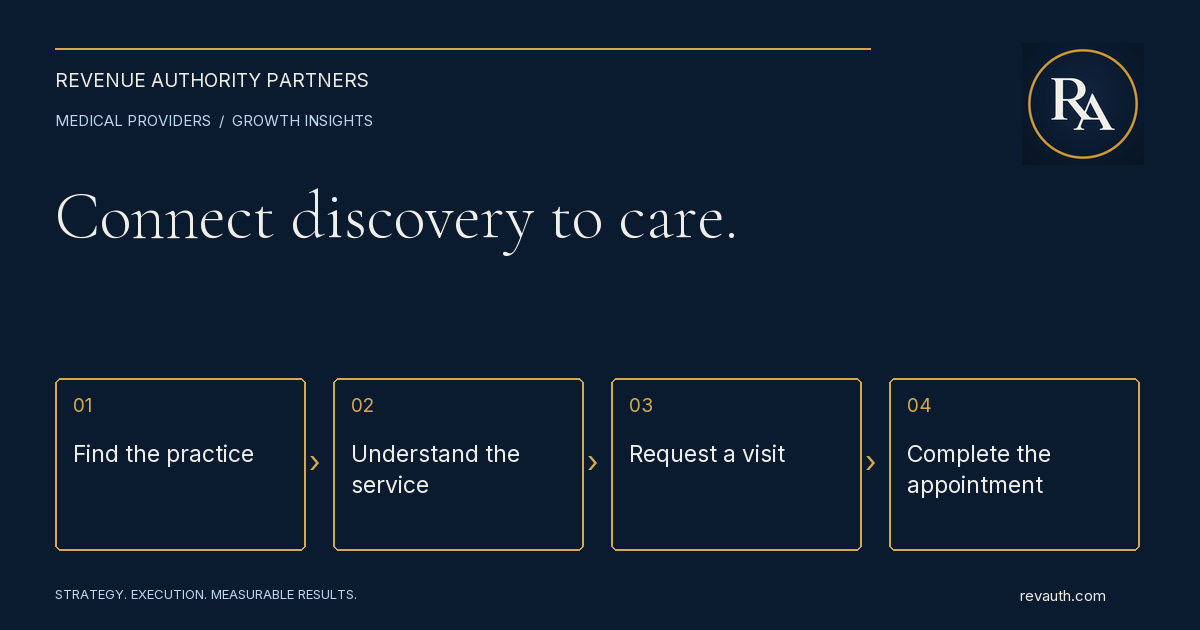
To attract new patients, a medical practice needs a clear service focus, accurate local information, useful website content, and a dependable path from inquiry to appointment. Start with the patients and services the practice can appropriately support, then connect marketing to scheduling capacity. More calls do not automatically produce more completed visits.
This guide is for practice owners, administrators, and growth leaders. It addresses business operations and patient communication, not clinical advice. Clinical suitability and care decisions belong to the practice's qualified professionals.
Choose a growth priority the practice can fulfill
Identify the services, locations, and appointment types where additional demand would be useful. Ask the scheduling and clinical teams what capacity exists and what limits apply. A campaign promoting a service with no realistic availability can create frustration for patients and extra work for staff.
Define the intended audience using relevant service needs and practical access information. Clarify which locations provide the service, what the appointment process involves, and which questions the scheduling team can answer. Keep the message accurate to the practice's actual capabilities.
Set a measurable objective beyond broad growth. The goal might be additional completed first appointments for a particular service at a location with capacity. Give the objective a time period and a responsible operational owner. This makes it possible to evaluate marketing and access together.
Understand where suitable patients discover you
List current sources: local search, the practice website, professional referrals, patient recommendations, advertising, community relationships, and other relevant channels. Ask scheduling staff which sources people mention and compare that information with available reporting. Keep uncertainty visible because people may encounter the practice several times.
Separate awareness from appointment intent. Someone reading educational content may not be ready to schedule. Someone searching for a specific service nearby may need practical access information immediately. Give each activity a role rather than expecting every visit to behave like a booking request.
Review source quality alongside availability. A source may generate interested people who cannot use the practice because of location, service fit, or scheduling constraints. That is a signal to improve the message, targeting, or access information, not automatically a reason to buy more traffic.
Make local information accurate and useful
Review the practice name, phone number, location details, office hours, and service descriptions across the website and business profiles. Confirm that links take people to the correct location or service page. Remove outdated information through the appropriate profile-management process.
Google identifies relevance, distance, and prominence as factors in local results. Read Google's local ranking guidance. A practice cannot control a searcher's location, but it can maintain accurate information and a website that clearly describes its services.
Provide directions, parking or access details, and contact instructions when helpful. If services differ by location, explain the difference. A prospective patient should not need to call several offices simply to learn which one provides the appointment they are seeking.
Build website pages around patient decisions
Each priority service page should explain what the practice offers, who provides the service when appropriate, where it is available, and how to request an appointment. Have clinical information reviewed by the appropriate professional. Avoid promising outcomes or implying suitability before an evaluation.
Include practical questions about scheduling, preparation, referrals, and payment or insurance information where the practice can provide accurate answers. Explain how information is verified and whom to contact when circumstances differ. Keep updates coordinated with the staff who answer those questions daily.
Use straightforward language. Medical terminology may be necessary, but explain it in the context of the patient's next decision. Long descriptions of the organization do not substitute for a clear explanation of the service and appointment pathway.
Remove friction from appointment requests
Test the entire journey on a phone. Check the phone link, request form, scheduling destination, confirmation, and staff notification. Distinguish an appointment request from a confirmed appointment so patients know whether someone still needs to contact them.
Keep the initial request proportionate to scheduling needs. Use the practice's approved secure channels for sensitive information. Do not encourage people to put medical histories into public comments, ordinary marketing forms, or social messages that are not intended for that purpose.
Assign ownership for incoming requests, unanswered calls, and rescheduling. Establish backup coverage and an escalation path when a request has no next step. Marketing can improve discovery, but the practice needs an operating routine that turns suitable interest into an actual appointment opportunity.
Coordinate referral and community relationships
Map the professional and community relationships relevant to the practice's services. Explain the process for appropriate referrals and how administrative questions are handled. Make it easy for referring offices to understand where to send requests through the practice's approved channels.
Track the operational follow-through: whether a referral was received, whether scheduling could proceed, and whether an access issue needs attention. Use the information the practice is permitted to handle and share. Do not design a marketing report that assumes unrestricted access to patient details.
Treat relationship development as an ongoing responsibility. A conference introduction or community meeting needs a named owner and a relevant next action. The objective is a dependable professional connection, not a list of contacts that never receive useful follow-through.
Measure completed appointments and improve the constraint
Track unique inquiries, successful contacts, eligible scheduling opportunities under the practice's definitions, booked appointments, and completed first visits. Keep cancellations, reschedules, and no-shows distinct. A booking campaign may appear successful while completed visits remain flat.
Review the stage with the strongest evidence of friction. If discovery is weak, investigate local visibility and relevant content. If inquiries are strong but bookings are low, inspect access information and scheduling. If bookings are healthy but attendance is weak, review the practice's approved reminders and preparation process.
Use aggregate reporting where appropriate and have the practice's privacy lead review tracking and vendor arrangements. A campaign's need for measurement does not justify collecting every detail available. Build the minimum reliable reporting needed for the decision.
Your first practical growth checklist
- Confirm services and locations with genuine appointment capacity.
- Correct public contact, access, and service information.
- Improve the priority service pages and mobile inquiry path.
- Assign request ownership and backup coverage.
- Establish source and appointment definitions with scheduling.
- Review completed visits and act on one clear constraint at a time.
RevAuth can support the connection between strategy, marketing execution, website improvements, scheduling workflows, and reporting. A useful growth plan gives patients clearer information and gives practice leadership a realistic view of what is happening after the first inquiry.
Common questions
What is the best way to get more patients for a medical practice?
Choose the channel mix after assessing services, location, current demand, and scheduling capacity. Accurate local information, useful service pages, appropriate professional relationships, and reliable request handling form a practical foundation. Measure completed appointments rather than assuming more website traffic means more patients.
Should a practice advertise when appointment availability is limited?
First identify which services or locations can support additional demand. Align the campaign with that capacity and communicate access accurately. If the advertised service is unavailable, increasing inquiries can create more frustration and administrative work without producing useful growth.
How can a practice tell whether marketing is working?
Connect source information with inquiry, booking, and completed first-visit counts under a consistent definition. Review those stages with scheduling and finance, while respecting privacy requirements. This helps distinguish a discovery problem from an appointment-access or attendance problem.
Share this guide
FacebookLinkedInPut the plan to work
Connect strategy with hands-on execution.
RevAuth helps law firms, medical providers, and established service businesses improve marketing, conversion, and the systems behind growth.
See if You QualifyRelated services
- Fractional CMO for Medical Providers & Practices
- SEO for Medical Providers & Practices
- Law Firm Intake & Patient Conversion Consulting
Continue reading
- Local SEO for Medical Practices: A Checklist for Google Maps and Search Visibility
- Why Your Medical Practice Website Isn’t Generating Appointment Requests