Medical Providers · Practical Growth Guide
How to Calculate Patient Acquisition Cost—and Find Where Your Marketing Is Losing Money
Calculate patient acquisition cost with clear spending and new-patient definitions, then use inquiry, booking, and completed-visit data to find improvement opportunities.
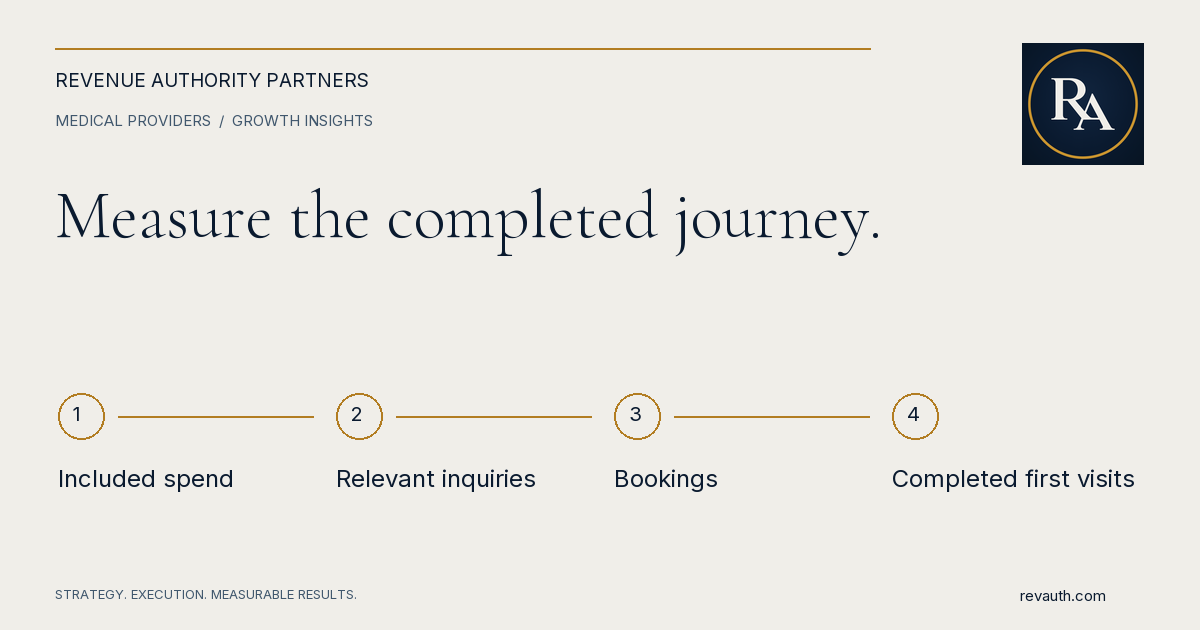
Patient acquisition cost equals the acquisition spending included in your definition divided by the number of new patients acquired under the same reporting definition. Start by deciding whether acquired means booked or completed a first appointment, which expenses belong in the calculation, and which period or inquiry cohort is being measured. Without those decisions, two reports can use the same label and describe different things.
For operating reviews, completed first appointments can provide a useful endpoint because a request or booking may not become a visit. The practice should choose the definition that fits the decision and keep intermediate stages visible rather than combining them into one number.
Write the formula and its boundaries
The basic calculation is simple: included acquisition costs divided by attributable new patients. The work lies in choosing and maintaining the inputs. Identify whether spending includes media only or also agency management, content, website work, software, and an allocated share of internal acquisition effort.
For planning arithmetic, $6,000 in included costs divided by 20 completed first appointments equals $300 per acquired patient. If the same period contains 30 bookings but only 20 completed first visits, cost per booking is $200 and cost per completed first visit is $300. These are calculation assumptions, not reported client outcomes or recommended targets.
Label the results precisely. A media-only cost per booking should not be compared with a fully loaded cost per completed first appointment as if they were equivalent. The formula becomes useful when everyone can see what the numerator and denominator contain.
Distinguish new patients from appointment activity
Agree on how the practice identifies a new patient for this report using its approved records and processes. A returning patient, rescheduled booking, duplicate request, or additional visit may not belong in the same acquisition denominator. Scheduling and finance should understand the rules the report uses.
Keep appointment stages distinct: requested, contacted, booked, canceled, rescheduled, no-show, and completed. A single person can generate multiple events. Deduplicate appropriately so the report does not count activity as several acquired patients.
Document how corrections are handled. Records may be updated after a reporting period closes. A consistent update routine prevents small administrative changes from becoming unexplained swings in performance. Show when figures are provisional and when they are mature enough for a particular decision.
Choose a time window that matches the journey
A monthly activity report is useful for staffing and spending reviews. A cohort report follows inquiries originating in a defined period through later bookings and visits. Use the latter when scheduling delays or later follow-up make same-month ratios misleading.
If a campaign generates requests near the end of the month, some appointments may occur the following month. Dividing the first month's spend only by visits completed before month-end can overstate the apparent cost. Conversely, attributing older demand to current spending can make a new campaign look better than the evidence supports.
Track enough context to interpret the period: changes in clinician availability, office hours, service offering, or campaign scope. A cost movement can reflect operational access rather than a sudden change in the quality of marketing.
Keep attribution honest
Use the source information the practice can appropriately and reliably maintain. People may discover a practice through a referral, read several pages, and later call after seeing an advertisement. A chosen attribution rule assigns reporting credit; it does not establish a complete causal history.
Keep unknown sources visible. Ask useful administrative questions without making patients complete a marketing survey before they can request care. Improve staff routines and data consistency over time rather than inventing source precision.
Have the practice's privacy lead review vendor access and data flows. Marketing measurement should not automatically receive clinical information or identifiable appointment details. A reliable aggregate view with clear limits can be more appropriate than a detailed report built on unapproved data collection.
Find where costs accumulate in the funnel
Compare cost per relevant inquiry, cost per booking, and cost per completed first visit. If inquiries are inexpensive but bookings are costly, examine service fit, contact, and availability. If bookings are reasonable but completed visits are costly, inspect cancellations, preparation information, and the approved reminder process.
Ask staff what they see in the records. Are people calling about a service the office does not offer? Are requests reaching a team that cannot schedule them? Are appointments being moved because availability information is stale? Those details turn an abstract cost ratio into a repairable operating question.
Use comparable segments. Different services and locations can have different demand and access patterns. A blended practice-wide average can hide a source that is useful for one service and poorly matched to another. Segment only as far as the data remains reliable and useful.
Compare acquisition cost with appropriate economics
Acquisition cost is an input to business planning, not a full profitability statement. The practice needs to consider actual collections, costs of care delivery, service mix, and cash timing. A low acquisition cost can still support an unfavorable service economics picture.
Be cautious with projected lifetime value. Future visits and collections depend on assumptions that may not be appropriate for a near-term spending decision. Use supportable records and finance review to determine how much weight to give those projections.
Decide the action threshold before expanding spend. The appropriate response to a rising cost may be a routing repair, a clearer service page, a narrower campaign, or a revised budget. A cost target without an operating explanation can encourage the team to optimize the reported number instead of the patient journey.
Keep a record of the decision made from each report. Note the observation, suspected cause, approved change, owner, and next review date. If the cost falls later, inspect whether appointment availability, source mix, or measurement also changed. This record helps the practice learn from the work without claiming that every improvement was caused by the latest campaign adjustment.
Use a compact acquisition review
- State the cost basis and acquired-patient definition at the top.
- Report inquiries, bookings, and completed first visits separately.
- Show source-unknown records and provisional cohorts.
- Note availability changes and other material operating context.
- Select one improvement with an owner, due date, and acceptance check.
- Reassess the same measure after a meaningful observation period.
Google's conversion measurement documentation explains that advertisers choose the actions they value. Review the conversion overview. For a medical practice, a platform event still needs to be distinguished from the practice's own booking and completed-visit definitions. RevAuth can help connect those business definitions with practical reporting and workflow improvements.
Common questions
What is a good patient acquisition cost?
An acceptable cost depends on the service, actual collections, delivery costs, available capacity, and financial objectives. Compare consistent definitions and use the practice’s own economics. A generic benchmark cannot determine whether a particular campaign is affordable or useful for your practice.
Should canceled appointments count as acquired patients?
They should remain visible in appointment reporting, but should not be counted as completed first visits. If the practice uses bookings as an acquisition endpoint, label that metric clearly and also track completion. Otherwise, a rise in cancellations can hide behind strong booking numbers.
Does patient acquisition cost include agency fees?
It can, depending on the declared cost basis. Report media-only and broader acquisition costs separately when helpful, and apply the same treatment across comparisons. Include management fees in a fully loaded calculation if that is how the practice defines it.
Share this guide
FacebookLinkedInPut the plan to work
Connect strategy with hands-on execution.
RevAuth helps law firms, medical providers, and established service businesses improve marketing, conversion, and the systems behind growth.
See if You QualifyRelated services
- Marketing Attribution & Performance Reporting
- Fractional CMO for Medical Providers & Practices
- Website Conversion Optimization
Continue reading
- How to Attract New Patients to Your Medical Practice: A Practical Growth Plan
- Local SEO for Medical Practices: A Checklist for Google Maps and Search Visibility