Law Firms · Practical Growth Guide
How to Improve Your Law Firm’s Intake Conversion Rate
Audit response, qualification, consultations, follow-up, and ownership to improve law firm intake conversion without confusing more leads with better cases.
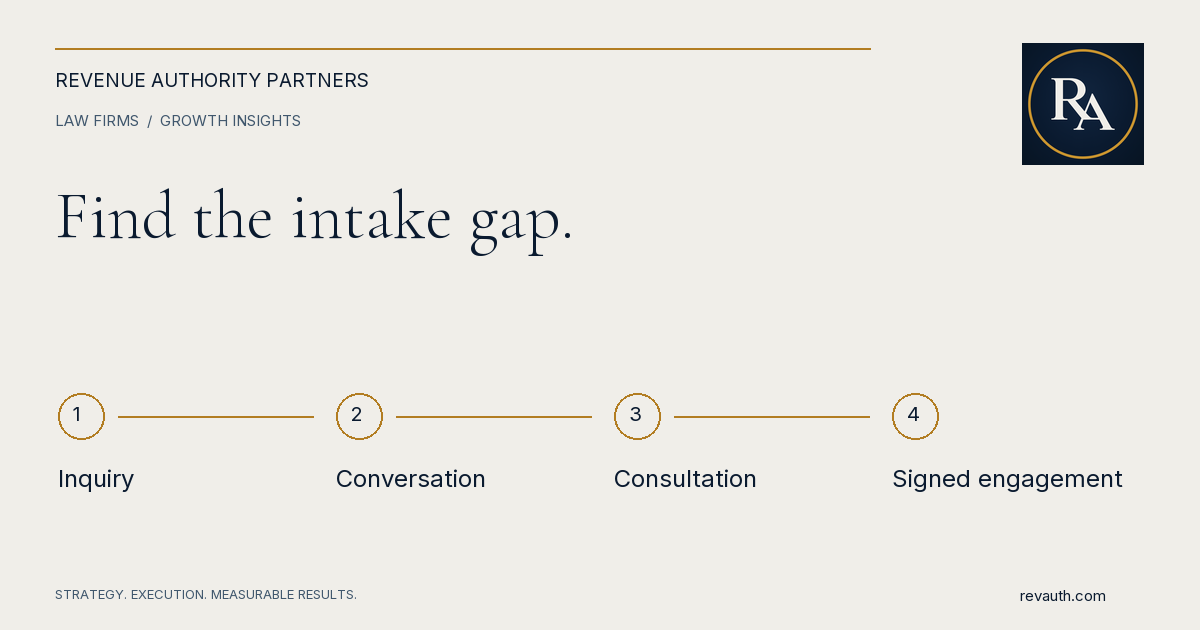
To improve a law firm's intake conversion rate, measure where relevant inquiries stop progressing, assign a person to each next step, and fix the largest preventable breakdown. Start with contact and qualification before judging the whole process by signed cases. A single overall percentage can hide unanswered calls, unsuitable inquiries, missed consultations, and delayed attorney decisions.
This is an operating framework for firm leaders and intake managers. The firm should control legal screening criteria, representation decisions, and the language used with prospective clients. Marketing and operations can improve the process without substituting for attorney judgment.
Define which conversion rate you mean
Intake conversion can describe several different ratios. Inquiry-to-contact rate measures successful conversations divided by unique inquiries. Qualified-inquiry-to-consultation rate measures completed consultations divided by inquiries that met the firm's initial criteria. Consultation-to-engagement rate measures signed engagements divided by completed consultations.
Use the denominator that matches the question. A large number of wrong-practice inquiries can depress inquiry-to-engagement performance even when the intake team handles suitable prospects well. Conversely, strong engagement rates among the few people who reach an attorney can hide a weak initial response process.
Document what counts as an inquiry, a duplicate, a qualification, and a signed matter. Keep a record of changes to those definitions. A better reported rate created by removing difficult prospects from the denominator is not evidence that the process improved.
Audit the first human response
Choose a recent, manageable sample of inquiry records across calls, forms, chat, and referrals. Review the time of arrival, the time of the first attempted response, the first successful conversation, and the next action. Separate staffed hours from after-hours arrivals so the team can see where coverage matters.
Inspect the experience itself. Does the phone menu make sense? Does voicemail explain what happens next? Does the form confirmation reach the person who submitted it? An automatic receipt is useful, but it is not the same as a meaningful conversation about the next step.
Create a response standard the firm can staff and measure. Assign backup coverage when the primary person is unavailable. Report both how quickly the team attempts contact and how often contact actually happens. The goal is a reliable process, not a speed claim unsupported by the firm's records.
Make qualification consistent and respectful
Build an attorney-approved intake guide around the firm's practice areas, service geography, conflict process, and initial eligibility questions. Explain which questions intake staff may answer and which require escalation. People should not receive different next steps simply because a different staff member answered the phone.
Keep initial information collection proportionate to the task. A prospect trying to find out whether the firm handles a matter may abandon a long questionnaire before speaking with anyone. Gather the details necessary to route the conversation, then use the appropriate secure process for additional material.
Record a reason when an inquiry is outside the firm's scope. Useful categories might include wrong practice area, geography, duplicate, unable to contact, or attorney declined after review. Avoid vague labels such as bad lead when the actual issue was that nobody reached the person.
Design the handoff to the attorney
The handoff should carry a concise summary, relevant documents through the approved system, a responsible attorney, and an expected next action. If a consultation requires preparation, tell the prospect what to bring and how the meeting will happen. Do not make the person repeat the same information to multiple teams without a reason.
Give staff an escalation path when an attorney has not reviewed a record by the expected time. A queue with no owner is a predictable source of delay. The escalation should clarify who can make the decision, who informs the prospect, and what gets documented.
Review consultation availability alongside campaign volume. If the next suitable appointment is too far away for the firm's own service standard, marketing cannot solve that bottleneck by sending more inquiries. Leadership must address capacity, routing, or the promise being made in the campaign.
Make follow-up a real workflow
Every open record should have a status, an owner, a next action, and a due date. Define the difference between awaiting documents, awaiting consultation, awaiting attorney review, and unable to contact. Those statuses need different actions; one generic pending bucket makes prioritization difficult.
Use approved communication channels and respect contact preferences and applicable requirements. Automation can create tasks, deliver approved logistical messages, and flag overdue work. Sensitive questions and decisions about representation need the appropriate human review. A task being generated does not mean the task was completed.
Close the loop when the person declines, the firm declines, or the matter is otherwise resolved. Keeping every record open makes the pipeline look larger while hiding what the team needs to learn. Review lost reasons as operating information rather than as a way to assign blame.
Coach with records, not anecdotes
Use a regular review of a limited sample of calls or interactions, subject to the firm's recording and confidentiality requirements. Look for clarity, empathy, accurate expectations, and a documented next step. Focus coaching on observable behavior that the team can change.
Compare similar groups. A referral from a trusted professional and a broad paid-social inquiry may arrive with different readiness. A new practice-area campaign may produce a different mix of questions. Segmenting those groups helps distinguish channel fit from intake execution.
Give a process change a clear test. If the team adds after-hours coverage, track contact and consultation outcomes for that group. If it simplifies the appointment handoff, track completed consultations and reschedules. Document simultaneous campaign changes so the team does not attribute every movement to one intervention.
A focused 30-day intake improvement plan
- Week one: agree on definitions, audit records, and test every inquiry route.
- Week two: fix ownership gaps, broken notifications, and missing backup coverage.
- Week three: introduce the approved qualification guide and specific follow-up statuses.
- Week four: review comparable inquiry cohorts and decide which improvement to keep.
Keep the scope small enough for staff to adopt. A perfectly designed workflow that nobody uses will not improve conversion. The first deliverable should be a working routine that supervisors can inspect and the team can maintain during a busy week.
For the professional context, the ABA addresses duties to prospective clients in Model Rule 1.18. The firm's applicable jurisdiction and counsel should guide its own intake procedures. RevAuth's role is to help align the operational pieces with the firm's approved process.
Common questions
What is a good law firm intake conversion rate?
A useful target depends on the practice area, source mix, qualification definition, and stage being measured. Establish a consistent baseline for comparable inquiries before adopting an external benchmark. Track contact, consultation, and engagement rates separately so the team knows what needs attention.
Can CRM software fix intake conversion?
Software can support routing, reminders, status reporting, and accountability. It cannot supply missing qualification decisions, attorney capacity, or staff adoption. Define the workflow and responsibility first, then configure software around that process and verify that it is used.
Should every lead receive the same follow-up sequence?
Use a consistent standard with appropriate branches for the person’s status, preferences, and the firm’s approved procedures. Someone awaiting attorney review needs a different next step from someone who missed a consultation. One undifferentiated sequence can create confusion.
Share this guide
FacebookLinkedInPut the plan to work
Connect strategy with hands-on execution.
RevAuth helps law firms, medical providers, and established service businesses improve marketing, conversion, and the systems behind growth.
See if You QualifyRelated services
- Law Firm Intake & Patient Conversion Consulting
- CRM Implementation & Optimization
- Personal Injury Law Firm Growth
Continue reading
- How Much Should a Law Firm Spend on Marketing? A Budget Planning Guide
- How to Generate Better Personal Injury Leads—and Turn Them Into Signed Cases