Law Firms · Practical Growth Guide
How Much Should a Law Firm Spend on Marketing? A Budget Planning Guide
Build a law firm marketing budget around capacity, signed-case goals, acquisition costs, and cash timing instead of an unsupported spending percentage.
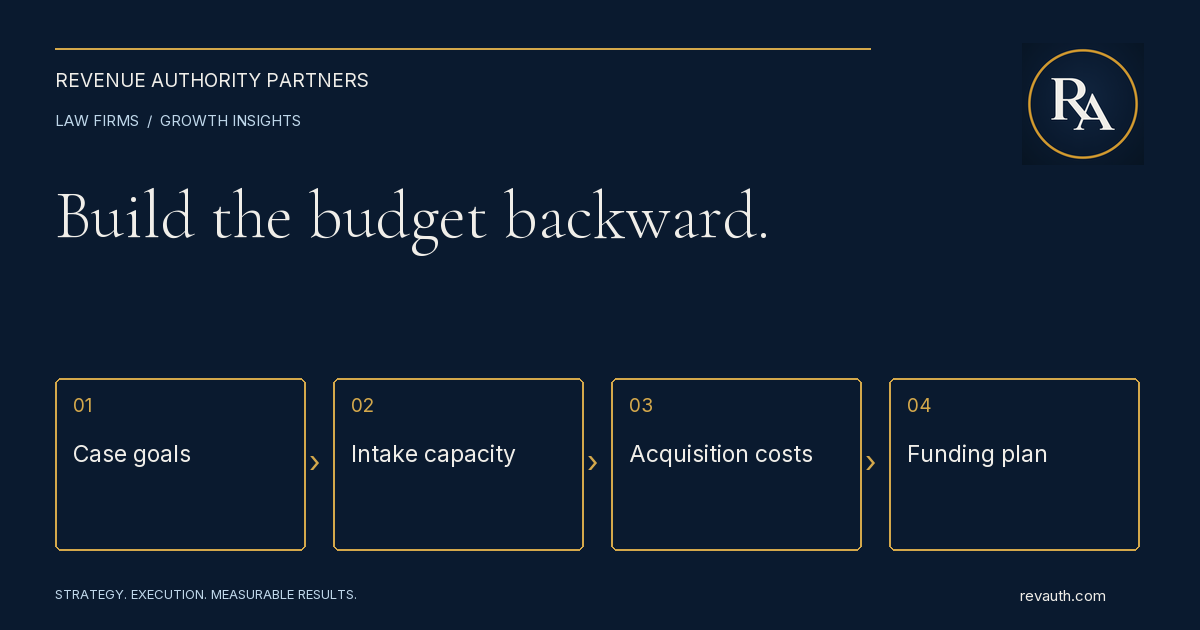
Law firms should build a marketing budget from their growth goals, ability to handle new matters, acquisition economics, and available cash. A percentage of revenue can be a reference point, but it cannot tell you whether the next dollar should go toward advertising, a better website, or fixing intake. The useful question is what investment the firm can support and what evidence will justify continuing it.
This guide provides a planning method for managing partners and firm administrators. It does not prescribe an industry benchmark. A personal injury practice funding long case cycles has different constraints from a firm collecting fees near the start of an engagement.
Start with the matters you can actually serve
Define the practice areas, geography, and case characteristics the firm wants. Then ask the attorneys and operations team how many additional matters they can handle without compromising service. A growth target needs room in attorney calendars, intake coverage, case management, and working capital. More inquiries are useful only when the organization can evaluate and serve the right ones.
Separate replacement demand from expansion. If normal attrition or completed matters will free capacity, some new work simply maintains the existing practice. Growth beyond that level requires additional capacity. Write both numbers down so marketing is not blamed for missing a target the firm never staffed to achieve.
Give the target a time period. Ten additional signed matters over a quarter calls for a different funding and measurement plan from ten each month. Where matters take time to qualify, define the inquiry cohorts that will produce the eventual engagements.
Work backward through your actual intake funnel
List unique inquiries, relevant inquiries, contacted prospects, completed consultations, and signed engagements. Use consistent definitions and remove duplicate submissions. Then calculate each stage conversion rate using records from a comparable period. If source information is incomplete, show the unknown group rather than spreading it across channels.
For planning arithmetic, suppose a firm wants eight signed matters and signs one in four qualified consultations. It would need 32 qualified consultations at that assumed rate. If half of relevant inquiries reach a consultation, it would need 64 relevant inquiries. Those are planning assumptions, not reported RevAuth client results or a performance promise.
Change the assumptions before changing the budget. Ask what happens if the consultation rate falls, case fit worsens, or the partner handling approvals is unavailable. A budget that works only under the best conversion assumption is fragile. A range makes the risk visible before the firm commits money.
Separate media spend from the full cost of growth
An advertising platform budget is only one line. The broader plan may include agency management, content, website work, creative production, reporting, software, and staff time dedicated to intake. Keep the categories separate so leadership can distinguish a channel test from a permanent operating commitment.
Use three funding buckets: ongoing essentials, time-limited improvements, and measured acquisition tests. Essentials keep the website and established channels functioning. Improvements address a defined constraint, such as broken form routing. Tests have a target audience, spend boundary, owner, and review date.
Avoid double counting. If an agency fee includes landing-page work, do not add the same work again under website development. If shared CRM software serves existing clients and prospects, document the allocation used for an acquisition report. Consistent accounting matters more than an artificially precise total.
Set an acquisition ceiling using firm economics
Cost per signed case equals the acquisition costs included in your definition divided by the signed matters attributable to those costs. It is an efficiency measure, not profit. A firm also needs to consider expected collections, costs of delivering the work, and uncertainty in the time until payment.
For contingency practices, an attractive projected fee is not cash available to pay next month's marketing bill. Keep a separate cash plan covering case expenses, payroll, and the period before collection. Use the firm's own historical outcomes and finance review rather than a generic online case-value claim.
Decide what evidence would make an acquisition cost acceptable. A low-cost signed matter outside the firm's preferred work may be less valuable than a more expensive matter that fits its capacity and economics. Record the reasoning so the target does not change whenever a campaign has a difficult week.
Fix the binding constraint before increasing spend
Review what happens after an inquiry arrives. Are calls answered? Do forms reach the right person? Are consultations scheduled promptly? Can the firm explain why a prospect did not proceed? If those steps fail, additional advertising can increase waste without changing signed-case volume.
Prioritize a repair when it has a clear owner, a testable outcome, and a direct connection to the constraint. A simpler consultation form may be more useful than a major redesign. Additional call coverage may matter more than another campaign. Assess the system rather than assuming every shortfall is a traffic problem.
Keep some acquisition activity running when it is producing suitable opportunities and the firm can support it. The decision is not automatically to stop marketing until operations are perfect. It is to fund a manageable level while improving the stage that is limiting results.
Approve a budget with decision rules
For every meaningful spend line, identify the purpose, monthly commitment, one-time cost, responsible person, and review date. Add a continuation rule: what information will support maintaining, increasing, reducing, or stopping the investment? The rule should account for the normal time needed for the channel to produce useful evidence.
Treat incomplete measurement as a repair task. Google Ads allows advertisers to define conversion actions such as calls or sign-ups; a platform conversion still needs an agreed business meaning. A phone interaction and an executed engagement are different milestones. Google explains conversion measurement here.
Use a monthly financial review and a shorter operational review. Weekly meetings can address missed calls and routing problems. Monthly or cohort-based reviews can assess acquisition cost and signed matters. Do not repeatedly rewrite a longer-term budget because a small weekly sample moved.
What to bring to a budget planning meeting
- The firm's desired matter mix and realistic intake capacity.
- Recent inquiry and consultation records with clear stage definitions.
- Advertising invoices, agency fees, software costs, and planned project costs.
- Historical collections and timing information appropriate to the firm's work.
- A list of operational constraints and the people responsible for fixing them.
- A funding range, a cash limit, and a date for the next investment decision.
The finished budget should explain how spending supports the firm's growth plan and who will act when results differ from assumptions. It should be understandable to the managing partner, finance lead, intake team, and agency without four competing versions of success. RevAuth can help connect those responsibilities through strategy, execution, and reporting.
Common questions
What percentage of revenue should a law firm spend on marketing?
There is no single percentage that fits every firm. Begin with capacity, growth goals, acquisition economics, and cash availability. A revenue percentage can be used as a reasonableness check after those factors are understood, rather than as the sole basis for approval.
Should intake improvements be part of the marketing budget?
Include the costs needed to turn new demand into suitable engagements, but show intake and channel spending separately. This lets leadership see whether a change improved acquisition efficiency, increased operating capacity, or simply moved an expense between departments.
When should a law firm increase its advertising budget?
Consider increasing a proven activity when inquiry quality is acceptable, intake can handle more volume, tracking is reliable enough for the decision, and the firm can fund the expected cash cycle. Specify a review point and a maximum commitment before increasing spend.
Share this guide
FacebookLinkedInPut the plan to work
Connect strategy with hands-on execution.
RevAuth helps law firms, medical providers, and established service businesses improve marketing, conversion, and the systems behind growth.
See if You QualifyRelated services
- Marketing Strategy & Budget Planning Services
- Personal Injury Law Firm Growth
- Marketing Attribution & Performance Reporting
Continue reading
- How to Improve Your Law Firm’s Intake Conversion Rate
- How to Generate Better Personal Injury Leads—and Turn Them Into Signed Cases