Law Firms · Practical Growth Guide
How to Generate Better Personal Injury Leads—and Turn Them Into Signed Cases
Improve personal injury lead quality by aligning case criteria, advertising, landing pages, intake, source reporting, and attorney review.
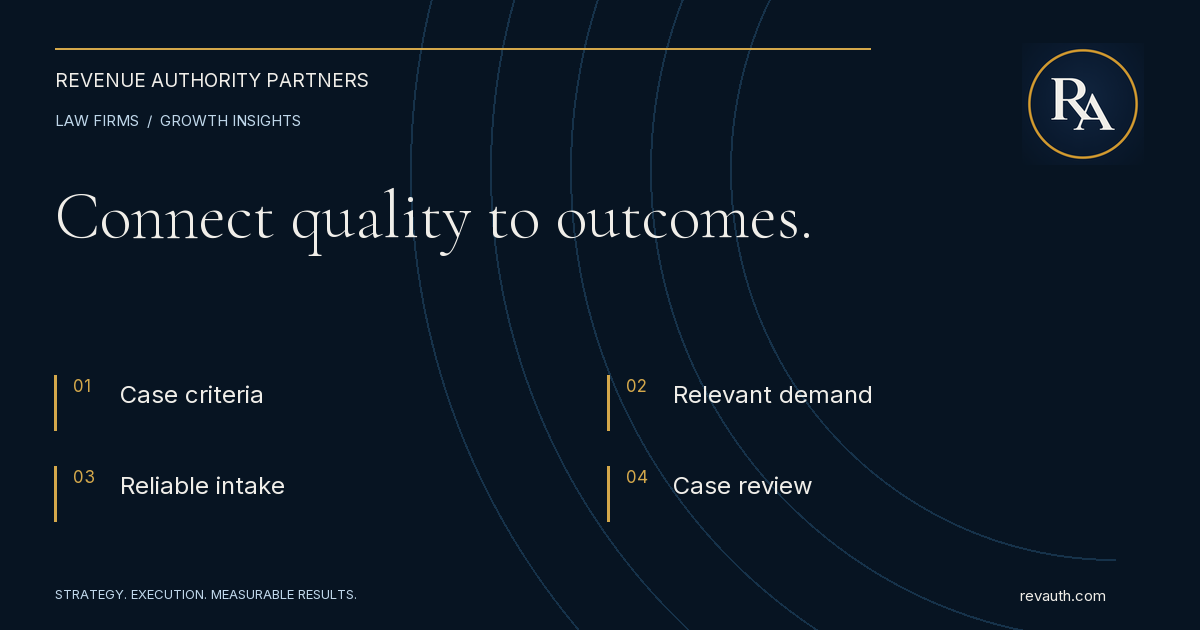
Better personal injury lead generation starts with a clear definition of the matters your firm wants, followed by advertising, website content, and intake that consistently reflect that definition. Measure the share of inquiries that become suitable, reviewed matters. A lower cost per lead is useful only if the firm can reach those people, evaluate their circumstances, and accept the right work.
No marketing process can guarantee that an inquiry becomes a signed case or that a case produces a particular result. The operating goal is to improve relevance, remove avoidable friction, and give attorneys better information for their decisions.
Define lead quality before buying more volume
Ask the attorneys to describe the matters the firm handles and the information needed for initial review. Capture practice scope, service geography, relevant incident categories, and factors that require attorney escalation. Keep legal judgments with the appropriate attorney rather than turning an advertising team's preference into a case-acceptance rule.
Translate those priorities into reporting categories. A relevant inquiry is different from a person who has been successfully contacted. A completed consultation is different from an accepted engagement. When every record is called a lead, a source with many duplicate forms can appear to outperform a source producing fewer useful conversations.
Write the definitions into the campaign brief and intake guide. Review them when the firm changes its desired matter mix. Otherwise, marketing may continue optimizing for a case category the attorneys no longer have capacity to serve.
Match the channel to how the person is looking
Search campaigns can reach people expressing an immediate need through a query. Educational content can help people understand what the firm handles and what to expect from an inquiry. Social advertising can introduce the firm to an audience that may not be actively searching at that moment. Each role calls for different messaging and measurement.
Judge a channel against the task assigned to it. A broad awareness campaign should not be presented as a direct-response program without an appropriate inquiry path. A high-intent search campaign should not send visitors to a generic homepage that leaves the relevant practice area unexplained.
Build referral relationships as a separate source of demand. Record the origin accurately and keep follow-through consistent. Any arrangements and communications involving referrals should follow the firm's own legal and professional requirements; a marketing workflow should not assume that a financial arrangement is permissible.
Use advertising that attracts the right inquiry
Ad copy should make the practice area, service geography, and next step understandable. Avoid making the message so broad that people reasonably expect services the firm does not provide. Review the words used in advertisements and the corresponding page together so the promise stays consistent throughout the experience.
For paid search, inspect the actual search terms where available and identify irrelevant intent. For social campaigns, review the questions people ask and the circumstances recorded at intake. Feed those observations into creative and audience decisions rather than treating campaign reporting as disconnected from the firm's conversations.
Use the firm's review process for claims, testimonials, and statements about outcomes. ABA Model Rule 7.1 addresses false or misleading communications about lawyer services; applicable rules depend on jurisdiction. Read the ABA model rule. Specificity and accuracy should guide the message before any performance optimization.
Build a landing page around the next decision
A person arriving from a relevant campaign needs to understand whether the firm handles the situation, how to contact it, and what will happen after an inquiry. Put that information near the top. Give the visitor a clear phone or form option, and ensure the page works on a real mobile device.
Answer practical questions without trying to replace a consultation. Explain the process for an initial conversation, the information the firm may request, and who will follow up. Avoid implying an attorney-client relationship is created simply because a visitor submits a form. Have the firm's approved language address those expectations.
Remove avoidable technical barriers. Test the form, confirmation, routing, and phone link. Check that a mobile visitor can read the content without zooming and complete the initial step without unnecessary fields. A campaign cannot compensate for an inquiry path that fails silently.
Treat intake as part of acquisition
Give every inquiry an assigned owner and an expected next action. Confirm coverage outside normal staffed hours and when the primary intake person is unavailable. An automated acknowledgement can confirm receipt, but it should not be counted as a successful intake conversation.
Create a structured handoff for attorney review. Include the necessary initial information in the approved system, the responsible attorney, and a visible decision status. If a record stalls, staff should know who can move it forward and what to communicate to the prospect.
Track why opportunities do not progress. Separate unable to contact from outside practice scope, duplicate, person declined, and attorney declined after review. That distinction tells the marketing team whether to change audience relevance, message, response process, or something else.
Measure quality by source and inquiry cohort
Report unique inquiries, relevant inquiries, successful contacts, consultations, and signed engagements for each meaningful source. Keep source-unknown records visible. Compare cohorts with enough time to progress rather than dividing this month's spend by cases signed from much older inquiries.
Calculate both cost per relevant inquiry and cost per signed case using a declared cost definition. The first helps diagnose demand quality. The second helps assess the acquisition process further downstream. Neither replaces the firm's review of case economics, staffing, and cash requirements.
Use sample review alongside totals. A small group of records can reveal that a campaign is attracting the wrong geography or that a qualification question is misunderstood. Do not turn a few observations into a universal conclusion; record the pattern, make a bounded adjustment, and review it again.
Decide what to improve first
- Many irrelevant inquiries: review targeting, search terms, page content, and the advertised promise.
- Relevant inquiries but few conversations: inspect routing, coverage, and contact attempts.
- Conversations but few consultations: review the handoff, scheduling options, and next-step explanation.
- Consultations but few engagements: ask the attorneys to review case fit and decision reasons.
- Signed matters but weak economics: revisit the acquisition costs, matter mix, and operating model.
The priority is the constraint with the strongest evidence and a realistic owner. RevAuth can help connect campaign execution, intake systems, reporting, and growth leadership so improvements follow the entire path from demand to attorney review.
Common questions
How can a personal injury firm improve lead quality?
Define the desired matters with attorneys, align the advertising and landing pages with that scope, and send intake outcomes back into source reporting. Track relevant inquiries separately from raw form submissions so volume does not hide a poor match.
Are cheaper personal injury leads always better?
No. Compare unique, relevant inquiries and signed engagements using the same cost definition and time window. Duplicates, wrong-geography inquiries, and people the team cannot reach can make a low initial price look more attractive than the eventual acquisition economics support.
Should a firm buy more leads before fixing intake?
Review capacity and the existing pipeline first. If suitable inquiries are going unanswered or waiting indefinitely for review, increasing volume can compound the problem. Maintain a manageable acquisition level while assigning and fixing the specific operational bottleneck.
Share this guide
FacebookLinkedInPut the plan to work
Connect strategy with hands-on execution.
RevAuth helps law firms, medical providers, and established service businesses improve marketing, conversion, and the systems behind growth.
See if You QualifyRelated services
- Personal Injury Law Firm Growth
- Social Media Advertising for Law Firms
- Referral Strategy & Business Development
Continue reading
- How Much Should a Law Firm Spend on Marketing? A Budget Planning Guide
- How to Improve Your Law Firm’s Intake Conversion Rate