Law Firms · Practical Growth Guide
How to Improve Your Law Firm’s Visibility in ChatGPT and Google AI Search
Make your law firm easier to understand in AI-assisted search through accessible pages, clear services, accurate attorney information, and useful answers.
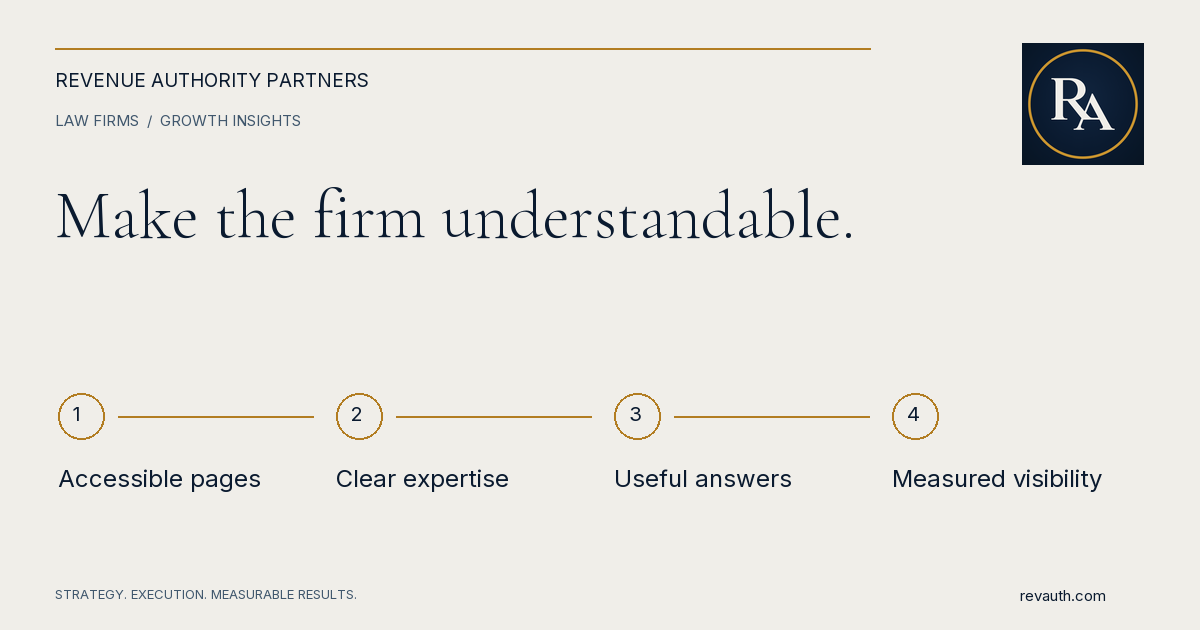
Law firms can improve their readiness for AI-assisted discovery by making public pages accessible, describing their services and attorneys accurately, and publishing useful answers to the questions prospective clients ask. These actions support a clear, trustworthy website. They cannot guarantee that ChatGPT, Google AI features, or another system will recommend the firm or cite a particular page.
The most useful starting point is an audit of what the internet can reliably learn about the firm. If the website disagrees with its profiles, buries its service geography, or offers only generic claims, publishing more AI-themed content will not resolve the underlying ambiguity.
Understand the difference between visibility and a recommendation
An AI system may mention a firm, link to its website, cite a page as a source, or omit it entirely. Those are different outcomes. A mention with incorrect practice information is not equivalent to a relevant referral, and a citation does not establish the quality of legal representation.
Keep expectations specific. The operational objective might be correcting the firm's identity, making priority service information accessible, or earning visits to a useful article. Choose a measure that reflects the objective rather than promising a fixed position in an answer that may vary by user and question.
Document the questions used when reviewing AI results, along with the date, system, and context. Repeating one prompt until the firm appears is not a meaningful measurement method. Use a consistent set of relevant questions and inspect the accuracy of the response as well as whether the name appears.
Preserve the technical foundations of search
Check that important pages load successfully, are linked from the public site, and have deliberate indexing instructions. Review canonicals, redirects, and sitemap coverage. Keep private pages excluded according to the firm's requirements. Do not open sensitive material to crawlers in pursuit of visibility.
Google states that established SEO practices remain relevant to its AI search features and that special AI markup is not required. Read Google's AI features guidance. The practical task is to make valuable public information available and understandable, not to add unsupported technical rituals.
For ChatGPT search discovery, OpenAI documents OAI-SearchBot separately from its training crawler. See OpenAI's crawler documentation. Have the website administrator review the current crawler policy deliberately; search accessibility and training preferences should not be treated as the same setting.
State who the firm is and what it handles
Use the firm's consistent name and clearly identify its attorneys, actual services, and relevant geography. Explain what the firm does in ordinary language. A visitor should not need to interpret a slogan to determine whether the practice handles the matter in question.
Build substantive attorney biographies using verified information. Include the details the firm is comfortable publishing and can support. Do not invent experience, awards, associations, or results to fill a template. When a biography is incomplete, obtain the missing information rather than using generic prestige language.
Review major third-party profiles for factual consistency. An old office address, former attorney, or outdated practice description can leave conflicting information available online. Keep a simple record of where corrections are needed and who owns each profile.
Write answers that help someone make a decision
Choose questions that fit the firm's actual practice and the reader's stage of understanding. An article can explain a process, clarify terminology, outline the information needed for an initial conversation, or identify questions to ask an attorney. The firm should review legal substance and jurisdictional context.
Give the answer near the beginning, then explain the conditions and limits. Use descriptive headings so a reader can find the relevant section. Add a checklist or comparison only when it improves understanding. Repeating the same phrase throughout a page does not make the answer more credible.
Connect each article to the appropriate service page and related guidance. The links should follow the reader's next question. Avoid producing multiple articles that answer the same question with slightly altered titles; a smaller set of complete, maintained pages can be easier to navigate and govern.
Make credibility inspectable
Show the responsible organization or approved author, a genuine publication date, and a review or update date when substantive work occurs. Link to primary sources when the article depends on external rules, definitions, or factual claims. Distinguish the firm's analysis from the source material.
Use structured data that accurately describes visible content. Article and organization information should agree with the page. Do not add a reviewer who did not review the article, a rating that does not exist, or a publication date chosen to create a false impression of freshness.
Maintain an editorial record. Keep the approved draft, source links, reviewer when applicable, and the reason for later changes. This helps a firm correct an outdated statement across its website and social distribution without guessing which version was published.
Measure referrals and business relevance
Track identifiable visits from AI assistants where analytics can observe them. Pair that information with inquiries and intake outcomes when appropriate. Some discovery may not produce a measurable click, and incomplete attribution should remain visible rather than being assigned to a preferred channel.
Review whether referred visitors reach relevant pages, make suitable inquiries, and understand the firm's services. A small number of relevant visits can be more useful than many unrelated mentions. Keep ordinary search reporting alongside AI observations so attention to a new channel does not obscure existing demand.
Use a repeatable review period. Record inaccurate mentions and potential content gaps, then decide whether a site correction or a new article is warranted. A changed response in one AI session is a signal to investigate, not proof that a website edit caused the change.
Include a factual correction workflow in the plan. If an answer points to an outdated attorney biography, first correct the underlying page or profile the answer cites. Keep the old and new information in the internal record, verify the live correction, and review the same question later. Repeated prompting cannot replace correcting the public source.
A practical starting sequence
- Verify crawl access and indexing instructions for priority public pages.
- Correct inconsistent firm, attorney, service, and location information.
- Select a focused group of questions based on actual inquiries and search data.
- Publish accurate answers with appropriate review, sources, and relevant links.
- Measure referrals, factual accuracy, and inquiry relevance over time.
RevAuth can help coordinate the website, content, reporting, and execution needed for that process. The work begins with a clearer public explanation of the firm and continues through maintenance and measurement, rather than ending when an article is published.
Common questions
Can a law firm guarantee placement in ChatGPT answers?
No. A firm can improve the accessibility and accuracy of its public information, but it cannot control another system’s answer or guarantee a recommendation. Treat guaranteed placement claims cautiously and ask what the provider will actually change, measure, and report.
Does AI search require a separate website?
A separate website is usually not the first task. Review the existing site’s accessibility, service information, useful content, and factual consistency. Any additional property should have a clear purpose and maintenance plan rather than duplicating the firm’s main site.
Should law firms publish answers to legal questions for AI visibility?
Publish material that is genuinely useful and within the firm’s approved editorial process. Have legal substance reviewed appropriately, identify jurisdiction when relevant, and avoid giving a reader a false impression that general information resolves their specific matter.
Share this guide
FacebookLinkedInPut the plan to work
Connect strategy with hands-on execution.
RevAuth helps law firms, medical providers, and established service businesses improve marketing, conversion, and the systems behind growth.
See if You QualifyRelated services
Continue reading
- How Much Should a Law Firm Spend on Marketing? A Budget Planning Guide
- How to Improve Your Law Firm’s Intake Conversion Rate