Law Firms · Practical Growth Guide
Law Firm SEO Audit Checklist: Why Your Website Isn’t Generating Qualified Leads
Audit law firm indexing, practice-area content, local visibility, mobile inquiries, and lead quality to prioritize the SEO fixes that matter.
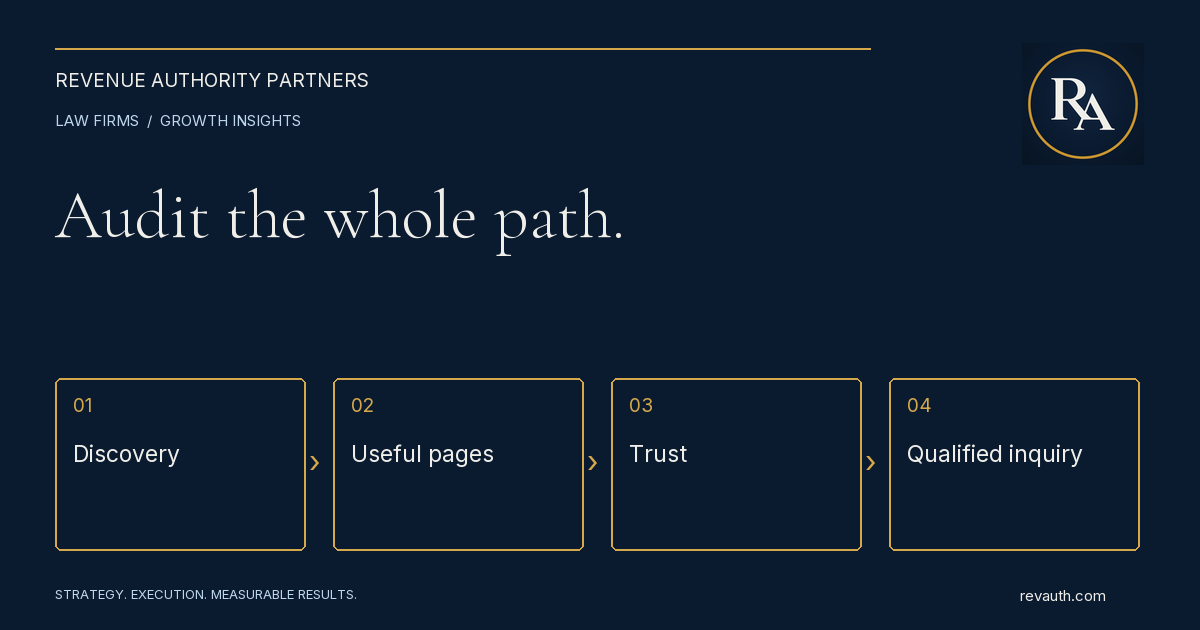
A useful law firm SEO audit connects technical accessibility, relevant content, local business information, and the inquiry process. Begin by asking whether search engines can reach the important pages, whether those pages address the firm's actual services, and whether visitors can take a clear next step. Rankings alone do not show whether the website attracts suitable prospective clients.
Work through this checklist with the person managing the website, the marketing partner, and someone who understands intake. The result should be a prioritized repair plan with owners and evidence, rather than a long export of issues that nobody knows how to interpret.
Establish the business and search baseline
List the practice areas, locations, and types of matters the firm wants to grow. Identify the pages intended to support each priority. Separate those service pages from educational articles: a page explaining how to hire a lawyer serves a different purpose from a page describing the firm's representation in a specific practice area.
Collect search impressions, clicks, and relevant query data from the firm's verified search reporting. Pair those figures with website inquiries and intake outcomes where measurement is available. A traffic decline matters differently if it affects an irrelevant article versus a page that consistently produces suitable consultations.
Record the period and any major site or campaign changes. Avoid comparing a short holiday week with a full normal week as if they were equivalent. Keep branded searches separate where possible so interest in the firm's name does not conceal weak visibility for its services.
Check indexing before rewriting everything
Review the sitemap, robots instructions, page status codes, and canonical URLs. Important public pages should be reachable through ordinary links. Confirm that a development setting or migration did not leave service pages marked noindex or blocked from crawling. Private contact or QR-only pages should remain excluded according to the firm's intent.
Use URL inspection on a sample of priority pages. Distinguish a submitted URL from an indexed URL, and an indexed URL from a page receiving meaningful search exposure. A sitemap helps discovery; it does not guarantee that a search engine will index every entry.
Inspect redirects and duplicate versions of important pages. If several URLs show the same content, identify the preferred address and align links and canonical signals. Do not treat every duplicate warning as a demand to delete a useful page without first understanding how the website works.
Match each page to a real search task
Read the title, main heading, introductory paragraph, and primary action together. A visitor should understand the service, location when relevant, and next step without decoding internal terminology. Avoid using the same generic title across unrelated practice areas.
Check whether the page answers practical questions specific to the service. Does it explain the firm's process, the scope of its work, and how an inquiry is handled? Can a reader distinguish it from other pages on the site? A long page assembled from repeated claims does not become more useful merely because it contains more words.
Google's people-first content guidance emphasizes usefulness and trustworthiness rather than writing to a prescribed word count. Review that guidance. Use completeness and clarity as editorial standards, then remove repetition that makes the next step harder to find.
Review local identity and location accuracy
Check that the firm name, contact details, office information, and service descriptions agree across the website and its business profiles. Investigate outdated phone numbers or locations rather than assuming every listing is current. A prospect should not have to guess which office handles the inquiry.
Location pages should represent real, supportable business information. Explain the office or service arrangement accurately and include details that help the visitor. Do not create dozens of nearly identical city pages that imply a local presence the firm does not have.
Review the connection between profile links and website destinations. If a profile sends visitors to an irrelevant page, the experience can break even when the listing itself is visible. Assign responsibility for keeping hours, contact details, and changes to services up to date.
Audit trust and professional accuracy
Check attorney names, credentials, practice descriptions, and factual claims. Make it clear who is responsible for the firm and how to reach it. If educational content addresses legal topics, have the firm's appropriate reviewer assess accuracy, jurisdictional context, and whether updates are needed.
Inspect testimonials, case descriptions, and claims about results through the firm's professional review process. Unsupported superlatives and ambiguous outcome statements can undermine trust. Preserve the context needed for a reader to understand what is being claimed.
Make the review workflow visible internally. Identify who approves factual changes, who publishes them, and who checks that the live page matches the approved version. A website can become inconsistent when separate teams update biography, service, and advertising copy without coordinating.
Test mobile conversion alongside search visibility
Open the site on a phone and complete the inquiry journey using appropriate test information. Check phone links, forms, validation, confirmation messages, and delivery to intake. Test pages reached directly from search, not only the homepage.
Look for obstructive menus, unreadable text, oversized banners, and buttons that are difficult to reach. Review performance using appropriate diagnostics and real user information when available. Prioritize problems that prevent visitors from understanding or contacting the firm before polishing minor visual details.
Then verify the operating handoff. If a form reaches an unmonitored inbox, the page may appear to convert while the firm loses the opportunity. SEO reporting and intake reporting should meet at the inquiry record rather than ending at a button click.
Retest the repaired page from a direct search-style entry, not only through the homepage navigation.
Turn the audit into a repair sequence
- Critical access: broken pages, unintended noindex rules, failed forms, or incorrect contact details.
- Relevance: unclear practice scope, weak page-to-query alignment, or duplicated service content.
- Trust: inaccurate biographies, unsupported claims, or stale information.
- Usability: mobile friction, confusing navigation, or unclear inquiry expectations.
- Measurement: missing source fields, duplicate conversions, or no connection to intake outcomes.
For each item, record the affected URL, evidence, business consequence, owner, and acceptance check. Fix a manageable group, verify the changes, and compare the relevant indicators over a suitable period. RevAuth can help translate an audit into coordinated website, content, intake, and reporting work.
Common questions
Why does my law firm rank but receive few inquiries?
Review query relevance, the page visitors actually reach, the clarity of the next step, and whether inquiry routes work. Visibility for broad informational searches may produce a different audience from searches for representation. Connect search performance with intake records before deciding that rankings alone prove success.
How often should a law firm run an SEO audit?
Use ongoing checks for critical functions and a deeper review after meaningful site changes, service changes, or unexplained performance movement. Set the cadence according to the site’s size and activity. The important part is assigning owners and verifying repairs, not repeatedly generating the same report.
Should every practice-area page become a blog post?
Keep service pages focused on the firm’s offering and use articles to address specific questions and decisions. Link the two when useful. Publishing a second page with the same purpose can split attention and leave visitors unsure which page contains the most complete answer.
Share this guide
FacebookLinkedInPut the plan to work
Connect strategy with hands-on execution.
RevAuth helps law firms, medical providers, and established service businesses improve marketing, conversion, and the systems behind growth.
See if You QualifyRelated services
Continue reading
- How Much Should a Law Firm Spend on Marketing? A Budget Planning Guide
- How to Improve Your Law Firm’s Intake Conversion Rate