Medical Providers · Practical Growth Guide
How to Improve Your Medical Practice’s Visibility in ChatGPT and Google AI Search
Improve medical practice AI-search readiness with accurate services, verified clinician information, public-page access, reviewed content, and responsible measurement.
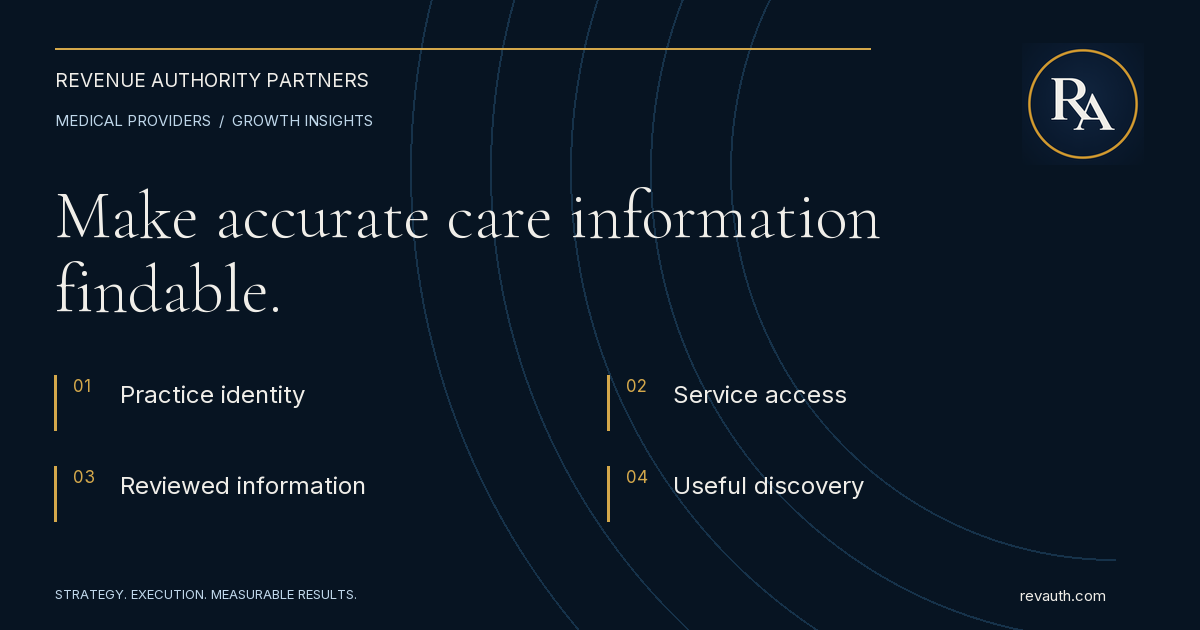
A medical practice can improve its readiness for discovery in ChatGPT and Google AI search by publishing accurate public information about its services, clinicians, locations, and appointment process. Keep important pages accessible, write useful answers, and review medical content appropriately. These steps improve the website's clarity and search foundations; they do not guarantee an AI recommendation or a particular citation.
For practices, accuracy is central to the work. A mention that misstates the location, available service, or appointment pathway can create confusion. The objective should be useful discovery by appropriate prospective patients, with clear boundaries between public information and individualized clinical advice.
Start with the information a prospective patient needs
List the services the practice actually provides, the locations where they are available, and the approved way to request an appointment. Check clinician names and credentials against the practice's verified information. Resolve contradictions before adding more content.
Ask the scheduling team which practical questions recur. People may need to understand whether a referral is required, which office handles a service, or how to confirm payment details. Publishing accurate access information can help both website visitors and the systems that retrieve public pages.
Keep the language understandable. Explain medical terminology when it is needed and avoid broad statements that imply everyone is a suitable candidate. The website can describe a service and its evaluation process without making a clinical decision for the reader.
Keep public search access separate from private systems
Review whether priority public pages can be reached through links and whether their indexing instructions match the practice's intent. Check the sitemap, canonical addresses, and redirects. Keep patient portals, private records, and internal tools outside the public content strategy.
Google says foundational SEO practices apply to its AI search features and that no special AI markup is necessary for eligibility. Read Google's AI search guidance. Useful public content and sound technical access remain practical starting points.
OpenAI distinguishes OAI-SearchBot, used for search discovery, from its training crawler. Review OpenAI's crawler documentation. The practice's administrator should assess those settings deliberately rather than treating search visibility as permission to expose nonpublic information.
Build service and location pages with specific value
Give each important page a clear purpose. A service page should describe what is offered, the relevant providers or team when appropriate, and the next administrative step. A location page should provide accurate access details and identify the services actually available there.
Add information that helps people distinguish the practice's arrangements, not invented claims of superiority. If appointment requests require a callback, explain that. If services differ by office, make the difference visible. Repeated slogans do not resolve practical uncertainty.
Link related information in a logical order. An educational article can lead to a service page, which can lead to the correct location and appointment pathway. Make those routes usable for a person without requiring an AI system to infer missing connections.
Publish reviewed answers to real questions
Choose topics from recurring administrative questions, appropriate patient education needs, and available search information. Distinguish clinical subjects from business or access topics so the right person reviews each type of material.
For clinical material, use the practice's qualified review process and appropriate primary references. Identify the responsible organization or approved author, and add review information only when that review actually occurred. Do not invent a physician reviewer or credential to make a page look more authoritative.
Answer the question near the beginning, then explain important conditions and limits. Use descriptive headings, readable paragraphs, and practical summaries. The structure should help the reader understand the material, not serve as a claim that a particular format guarantees citation by an AI assistant.
Maintain a consistent public identity
Review the practice website, business profiles, professional directories, and other controlled properties for factual consistency. A location change or departed clinician may leave older information online. Keep a correction list with an owner for each property.
Use structured data only where it accurately describes visible information. The organization, article, and page details should agree with what a visitor can read. Adding technical fields cannot make unsupported credentials, ratings, or medical claims trustworthy.
Set a maintenance routine. Date substantive updates honestly and review content when services, clinicians, locations, or access processes change. A page can remain useful over time when someone owns its accuracy rather than treating publication as the end of the work.
Protect privacy while reviewing discovery
Do not submit patient information to public AI tools to test whether the practice appears. Use general service and location questions relevant to the practice. Keep the review separate from individual care decisions and confidential records.
Review identifiable AI referrals in analytics only within the practice's approved measurement arrangements. Some discovery will not generate an observable visit, and a referral label may not capture the whole journey. Keep those limits visible instead of attributing every unexplained inquiry to AI.
Coordinate with the privacy lead before adding tracking or connecting appointment systems to marketing vendors. The desire to measure a new channel does not change the need for appropriate handling of the information involved. Use the minimum reliable data needed for the operating decision.
Evaluate accuracy and relevance over time
Maintain a small, consistent set of nonpatient-specific questions. Record the date, system, question, and what the answer says about the practice. Check the factual details and linked destinations rather than recording only whether the name appears.
Compare those observations with relevant website visits and inquiry outcomes where available. A change in one answer does not prove that a recent site edit caused the change. Look for patterns and use them to identify factual corrections or useful content gaps.
Prioritize an improvement the practice can own: correcting an office page, publishing a reviewed explanation, repairing a request route, or clarifying a service. RevAuth can help coordinate these website, content, and reporting tasks while the practice retains control of clinical accuracy and privacy decisions.
A starting checklist for practice leaders
- Verify services, clinician information, locations, and appointment instructions.
- Confirm that appropriate public pages are accessible and private systems stay excluded.
- Choose useful questions and assign the correct editorial reviewers.
- Publish clear, sourced information with accurate dates and attribution.
- Review factual consistency across controlled profiles.
- Measure relevant discovery and inquiries with explicit reporting limits.
The strongest foundation is an accurate, useful explanation of the practice that people can navigate and the organization can maintain. Treat AI visibility as part of that ongoing public-information responsibility rather than as a shortcut around ordinary search and patient communication work.
Common questions
Can a medical practice guarantee that ChatGPT recommends it?
No. Practices can improve the accuracy, accessibility, and usefulness of public information, but they cannot control an AI system’s answer. Evaluate providers by concrete deliverables, factual accuracy, and relevant discovery rather than a guaranteed recommendation.
Should we publish more medical articles just for AI search?
Publish when the practice can provide a useful, accurate answer and maintain it. Clinical topics need appropriate professional review. Expanding page count without clear purpose, factual oversight, or an update process can make the website harder to manage without improving its usefulness.
How do we measure AI-search visibility for a practice?
Use a consistent set of general questions to review factual accuracy and citations, then assess identifiable referral visits and appropriate inquiry outcomes where available. Do not use patient information in public prompts, and state the limitations of the measurement.
Share this guide
FacebookLinkedInPut the plan to work
Connect strategy with hands-on execution.
RevAuth helps law firms, medical providers, and established service businesses improve marketing, conversion, and the systems behind growth.
See if You QualifyRelated services
Continue reading
- How to Attract New Patients to Your Medical Practice: A Practical Growth Plan
- Local SEO for Medical Practices: A Checklist for Google Maps and Search Visibility