Medical Providers · Practical Growth Guide
How Much Should a Medical Practice Spend on Marketing?
Plan a medical practice marketing budget using appointment capacity, patient acquisition costs, service priorities, cash limits, and accountable review points.
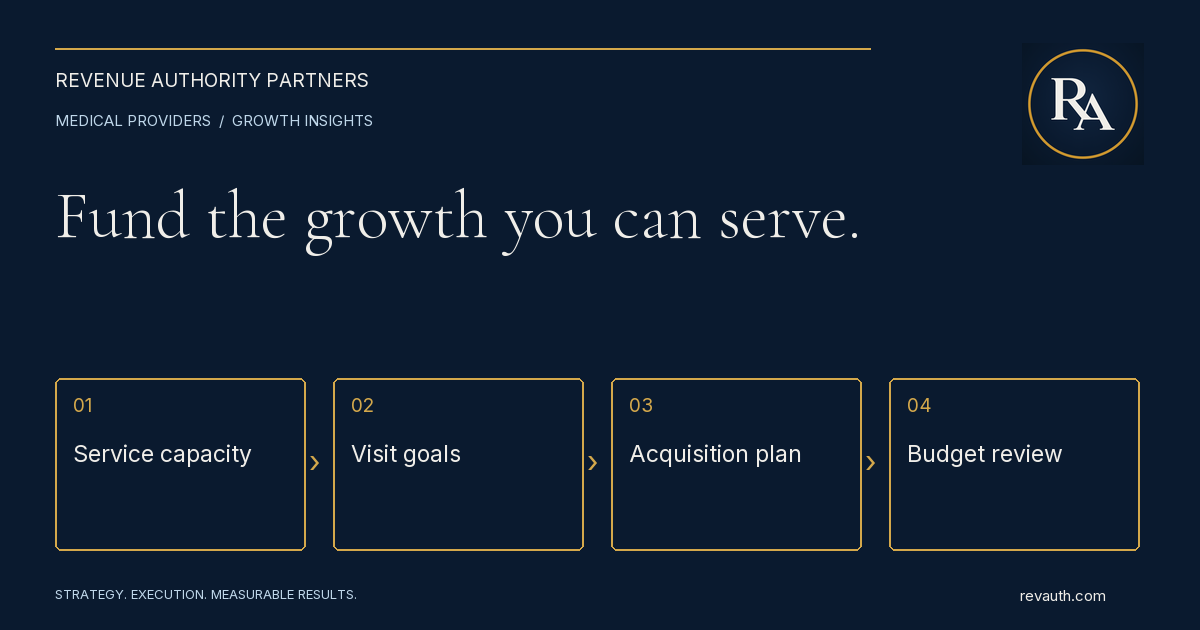
A medical practice should set its marketing budget around the services it wants to grow, the appointments it can deliver, its acquisition economics, and its available funding. A fixed percentage of revenue cannot account for all those variables. Begin with a realistic completed-visit goal and work backward through scheduling and acquisition assumptions.
This planning method is intended for owners and administrators who need to coordinate marketing, operations, and finance. It is not a universal spending benchmark. A new practice establishing awareness faces different needs from an established practice trying to fill selected service capacity.
Start with service capacity and access
Ask which locations, clinicians, and appointment types can support additional demand. Review scheduling availability, staff coverage, and any constraints on the services being promoted. Marketing should not create an access promise that the practice cannot fulfill.
Distinguish new capacity from unused capacity. Adding a service, opening an office, and filling existing appointments call for different plans. The first may require launch materials and operational setup; the last may need a narrower acquisition or scheduling improvement.
Write a concrete objective, such as additional completed first appointments for a specific service over a defined period. Avoid treating all patients or visits as interchangeable. The practice's clinical and operational leaders should determine which growth is appropriate and manageable.
Establish the acquisition and scheduling baseline
Collect available counts for unique inquiries, successful contacts, scheduling opportunities, booked appointments, and completed first visits. Define each stage with the people who maintain the records. If a request is awaiting confirmation, do not report it as an appointment already on the calendar.
Review the source mix and the amount of missing information. Professional referrals, local discovery, advertising, and existing-patient recommendations can play different roles. Keep unknown attribution visible rather than assigning every unclassified appointment to a paid campaign.
Use comparable periods and note changes in availability. A low booking rate during a period with limited appointment access does not necessarily mean the campaign attracted the wrong people. The budget review needs enough operating context to identify the actual constraint.
Work backward from completed first visits
For planning arithmetic, suppose the practice wants 24 additional completed first visits. If it assumes 80 percent of booked first visits will be completed, it needs 30 bookings. If half of relevant inquiries produce bookings, it needs 60 relevant inquiries. These assumptions are a planning calculation, not a practice benchmark or reported RevAuth result.
Test less favorable assumptions as well. What if availability changes, contact rates fall, or the source mix produces fewer appropriate scheduling opportunities? A budget range makes those risks visible before spending begins.
Keep the planning target separate from a forecast presented as certain. Review assumptions against actual outcomes and revise them when the evidence changes. A useful plan helps the team make decisions; it does not hide uncertainty behind a precise-looking spreadsheet.
Separate ongoing costs, projects, and acquisition tests
List the ongoing costs required to maintain the website, existing content, reporting, and established channels. Then identify one-time work such as a service-page rebuild, scheduling integration, or new-location launch materials. Finally, define the advertising or outreach tests proposed for the period.
Show media spend separately from management, creative, software, and internal effort. If a vendor package includes several services, clarify what is covered and what would be charged separately. This prevents leadership from approving a media figure that understates the actual commitment.
Allocate shared costs consistently. A website supports existing patients and new demand, and some software serves several teams. Use an allocation the practice can explain instead of changing the treatment each month to improve the apparent acquisition cost.
Evaluate affordability with finance
Patient acquisition cost measures included acquisition spending per new patient under the practice's declared definition. It is not the same as profit per patient. Leadership also needs to consider collections, the costs of delivering care, timing, and the service mix.
Use conservative, supportable financial assumptions. Avoid funding marketing from an optimistic lifetime-value figure that assumes future visits without a clear basis. A near-term contribution and cash view may be more useful for approving a manageable test.
Set a cash boundary and a review point. The practice should know the maximum commitment, when invoices are due, and what evidence is needed to continue. Appropriate finance and compliance review should guide the specific business arrangement; marketing reporting should not replace those responsibilities.
Fund the constraint that limits useful growth
If service information is unclear, page improvements may be the priority. If relevant people inquire but cannot reach scheduling, call handling or request ownership may matter more. If access is reliable but discovery is weak, local visibility, content, or a measured advertising test may be appropriate.
Compare proposed spending with the problem it is meant to solve. A large redesign should have a scope connected to observed issues. Additional advertising should have an inquiry path and staff capacity ready to receive demand. Each investment needs a person responsible for the operating outcome.
Avoid stopping every acquisition activity while improving operations if a manageable existing source is producing suitable appointments. The practical goal is coordinated pacing: fund demand the practice can support while repairing the stage that is preventing further progress.
Build privacy review into measurement planning
Decide which information is actually needed to assess the campaign. Use appropriate aggregate reporting and approved systems. Do not assume that marketing platforms should receive patient identities, appointment details, or clinical information simply because that would make attribution easier.
HHS discusses online tracking obligations and notes that part of its guidance was vacated by a court ruling. Review the HHS tracking bulletin. Have the practice's privacy lead assess the actual data flows and vendors rather than relying on an all-purpose claim that a tool is safe for every use.
Include measurement setup and review in the project scope. A budget should not depend on data collection the practice has not approved. Identify limitations in the report and make decisions using the reliable information available.
What an approved budget should contain
- Priority services, locations, and realistic appointment capacity.
- A completed-visit objective and the assumptions behind it.
- Ongoing costs, one-time improvements, and bounded acquisition tests.
- A consistent acquisition-cost definition and appropriate financial review.
- Approved measurement arrangements and known reporting limitations.
- Owners, cash limits, and dates for continuing or changing the plan.
RevAuth can help coordinate that plan across marketing execution, website development, scheduling workflows, and leadership reporting. The budget should make the work more accountable and help the practice distinguish a need for more demand from a need for better follow-through.
Common questions
What percentage of revenue should a medical practice spend on marketing?
There is no single percentage that answers the question for every practice. Start with services, capacity, growth objectives, acquisition assumptions, and cash availability. Use a revenue percentage as a secondary reasonableness check rather than the only basis for an investment decision.
Should a new practice budget differently from an established practice?
Yes. A new practice may need foundational website, profile, and launch work before acquisition tests can be evaluated. An established practice may have existing demand and a specific scheduling constraint. Separate setup costs from recurring spending so comparisons remain understandable.
When should a medical practice increase marketing spend?
Consider increasing a proven activity when the practice can serve more appropriate demand, request handling is reliable, measurement supports the decision, and the financial commitment is affordable. Set the review point and spending boundary before expanding the activity.
Share this guide
FacebookLinkedInPut the plan to work
Connect strategy with hands-on execution.
RevAuth helps law firms, medical providers, and established service businesses improve marketing, conversion, and the systems behind growth.
See if You QualifyRelated services
- Marketing Strategy & Budget Planning Services
- Fractional CMO for Medical Providers & Practices
- Marketing Attribution & Performance Reporting
Continue reading
- How to Attract New Patients to Your Medical Practice: A Practical Growth Plan
- Local SEO for Medical Practices: A Checklist for Google Maps and Search Visibility