Medical Providers · Practical Growth Guide
How to Improve Medical Referral Management and Scheduling Follow-Through
Improve medical referral management with clear status definitions, accountable handoffs, patient scheduling workflows, and closed-loop follow-through.
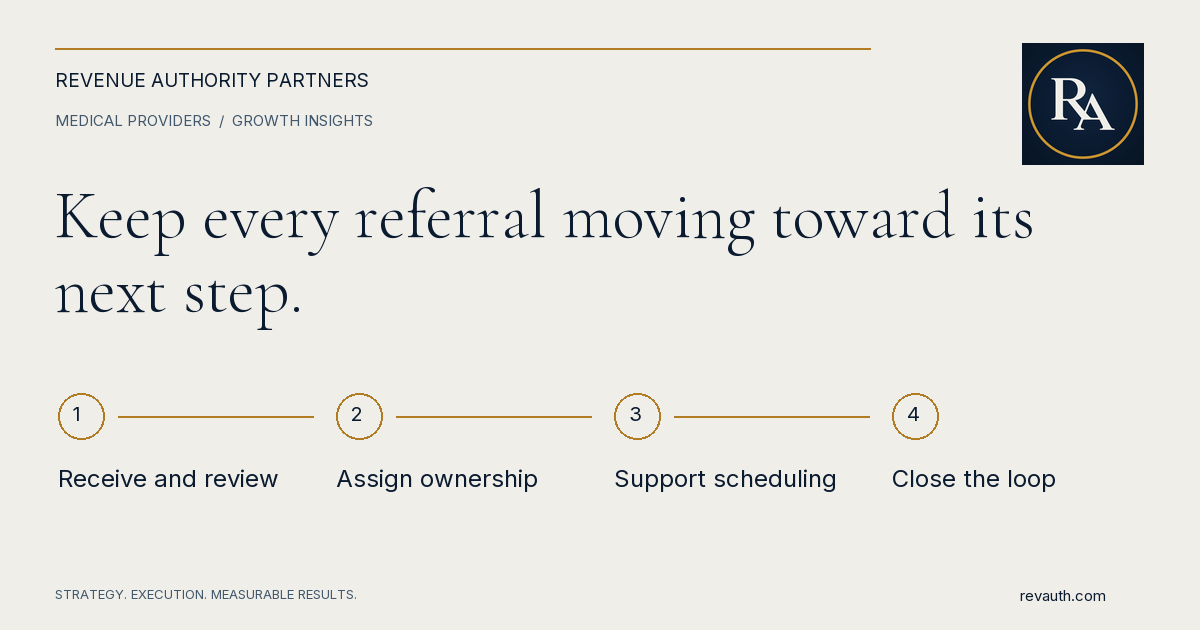
Medical referral management works better when every referral has a visible status, a responsible owner, and a clear next action. Sending a referral or entering an appointment does not establish that the patient received the intended care or that the referring clinician received the relevant information. For a practice improving scheduling follow-through, start by mapping the path from referral receipt to review, patient contact, scheduling, attendance, and return communication. Keep clinical priority and care decisions with qualified clinicians. The operating goal is to make the next step dependable, while giving staff a manageable way to find exceptions before they disappear into an inbox.
Map the referral path before buying software
Follow a small sample of actual referrals through the systems your team already uses. Identify where each arrived, who reviewed it, whether required information was present, how the patient was contacted, and what happened after the appointment. Use authorized access and the practice's privacy procedures throughout the review. Distinguish inbound referrals from outbound referrals. A receiving practice needs to know whether an inquiry was accepted, whether it can proceed to scheduling, and what the referring team needs back. A referring practice needs a way to track whether the receiving organization acknowledged the referral and whether the expected report returned. Write down the handoffs between organizations as well as the steps inside your office. Software may make a queue more visible, but it will not decide who owns an unanswered request or how clinical concerns should be escalated. Resolve those responsibilities before automating the workflow.
Define statuses that describe what actually happened
Use a short set of operational statuses with written definitions. These might include received, awaiting information, awaiting clinical review, ready for patient contact, scheduled, attended, and awaiting return communication. Adapt the list to the practice and distinguish a completed action from a planned one. A referral marked “scheduled” should have an appointment associated with it. A referral marked “contacted” should distinguish a completed conversation from an unanswered call or message. A record closed after a patient declines should preserve that reason under the practice's retention and documentation policies. Keep administrative status separate from clinical interpretation. Scheduling staff should not decide that a referral is unnecessary, determine urgency from a generic keyword, or substitute a routine reminder for an established clinical escalation process. Clinicians should approve how priority and time-sensitive concerns enter the workflow.
Give each queue an owner and an escalation path
Every active referral needs a person or monitored team responsible for moving it forward. Assign coverage for absences and identify who can resolve missing information, appointment availability, patient questions, and unresolved communication with another provider. An inbox shared by everyone can still be owned by nobody. Set review intervals that reflect the practice's approved priorities and resources. The interval for an administrative completeness check is different from a clinical review target. Avoid a single deadline that makes every referral appear equally urgent or encourages staff to interpret medical information beyond their role. Use an exception list for referrals that have not reached the expected next step. The Institute for Healthcare Improvement's referral management guide describes a closed-loop approach that addresses roles and communication across the referral journey. Apply that principle by making unresolved handoffs visible to the people responsible for resolving them.
Check completeness without creating repeated work
Agree on the information needed for each administrative stage and who confirms it. Depending on the service and the practice's procedures, that may involve referral details, appropriate records, patient contact information, or a separately managed authorization requirement. Do not confuse insurance authorization with clinical acceptance or a guarantee of coverage. When information is missing, create one specific request with an owner and a follow-up date. Record what was requested and from whom, so the next staff member does not send a duplicate request or tell the patient that a different item is missing. Use secure, approved channels for records. A referral tracking spreadsheet or general sales CRM should not become an uncontrolled second medical record. Ask the practice's privacy and security leads to approve systems, access, vendor arrangements, and retention before expanding where patient information is stored.
Make patient contact useful and easy to act on
Explain who is contacting the patient, what administrative action is needed, and how to reach the appropriate team. Ask staff to use the practice's approved wording rather than offering medical explanations or making assumptions about what the referring clinician told the patient. Confirm contact preferences and the practice's rules for messages. A useful scheduling message can be brief and provide a reliable callback route. Avoid placing a detailed diagnosis, referral narrative, or sensitive document in an ordinary reminder simply because the system allows a long message. HHS guidance on messages to patients explains that providers may communicate about care while using reasonable safeguards and limiting what they disclose in messages. Have the practice translate those principles into channel-specific templates and handling of confidential communication requests. Other applicable communication requirements still need review.
Design scheduling around a clear handoff
Once a referral is ready for scheduling, give staff a defined method for finding an appropriate appointment or routing an availability problem. Clinical appropriateness belongs with the relevant professionals. Administrative staff need an approved way to ask for help when the available slots do not fit the approved scheduling instructions. Confirm the appointment details and any practice-approved preparation information through the agreed channel. Make cancellation and rescheduling instructions easy to find. A patient who cannot attend needs a practical route back into the scheduling process, rather than a sequence of reminders for an appointment they can no longer keep. Record the result of each interaction and the next action before closing the task. If the patient needs to call back, decide who monitors whether that happens. A vague note such as “will schedule later” should not remove the referral from view without the practice's approved disposition process.
Handle cancellations and missed visits deliberately
Separate a cancellation, a rescheduled appointment, and a missed visit in reporting. They create different tasks and may require different communication. Use the practice's approved escalation process when a missed appointment raises a clinical concern; a marketing automation should not determine the significance of the event. For routine administrative follow-up, assign an owner and an approved contact sequence. Keep attempts distinct from successful conversations. Record patient preferences and stop or change the sequence when the practice's policy requires it. Avoid sending reminders indefinitely because an integration failed to update a status. HHS describes appointment reminders as part of treatment under the HIPAA Privacy Rule. That does not establish permission for unrelated marketing or remove other applicable obligations. Our guide to reducing patient no-shows discusses the operational side of reminders and follow-through.
Close the loop and measure the unresolved work
Define what closure means for each referral type. Attendance may be one milestone, while receipt and routing of the expected specialist communication is another. Assign responsibility for checking whether the information returned and for routing clinical content to the appropriate reviewer. Staff should not mark clinical review complete on someone else's behalf. Review counts at each stage, time spent waiting, incomplete requests, unsuccessful contact attempts, scheduling outcomes, and unresolved return communication. Use consistent definitions and an appropriate reporting period. A referral that arrived recently should not be interpreted like one that has been waiting for weeks. Start improvement with one recurring failure point. Test a clearer request template, a covered queue, or a reliable handoff, then check whether it reduced unresolved work without creating another burden. RevAuth helps medical providers connect patient conversion processes, CRM implementation, and performance reporting. To discuss hands-on operational and marketing support, See if You Qualify.
Common questions
What is medical referral management?
It is the process of tracking and coordinating a referral through receipt, review, patient contact, scheduling, attendance, and the appropriate return communication. Clinical decisions remain with qualified professionals.
How can a practice improve referral scheduling?
Define readiness for scheduling, assign queue ownership and backup coverage, record patient contact preferences, and create an escalation path for missing information or availability problems.
Does scheduling an appointment close a referral?
Scheduling is a milestone. The practice should define closure for each referral type, including attendance and receipt and routing of expected specialist communication where appropriate.
Share this guide
FacebookLinkedInPut the plan to work
Connect strategy with hands-on execution.
RevAuth helps law firms, medical providers, and established service businesses improve marketing, conversion, and the systems behind growth.
See if You QualifyRelated services
- Law Firm Intake & Patient Conversion Consulting
- CRM Implementation & Optimization
- Marketing Attribution & Performance Reporting
Continue reading
- How to Attract New Patients to Your Medical Practice: A Practical Growth Plan
- Local SEO for Medical Practices: A Checklist for Google Maps and Search Visibility