Law Firms · Practical Growth Guide
Personal Injury Intake Scripts: Questions, Handoffs, and Follow-Up
Build a personal injury intake script with approved questions, clear attorney handoffs, accountable follow-up, and practical quality checks.
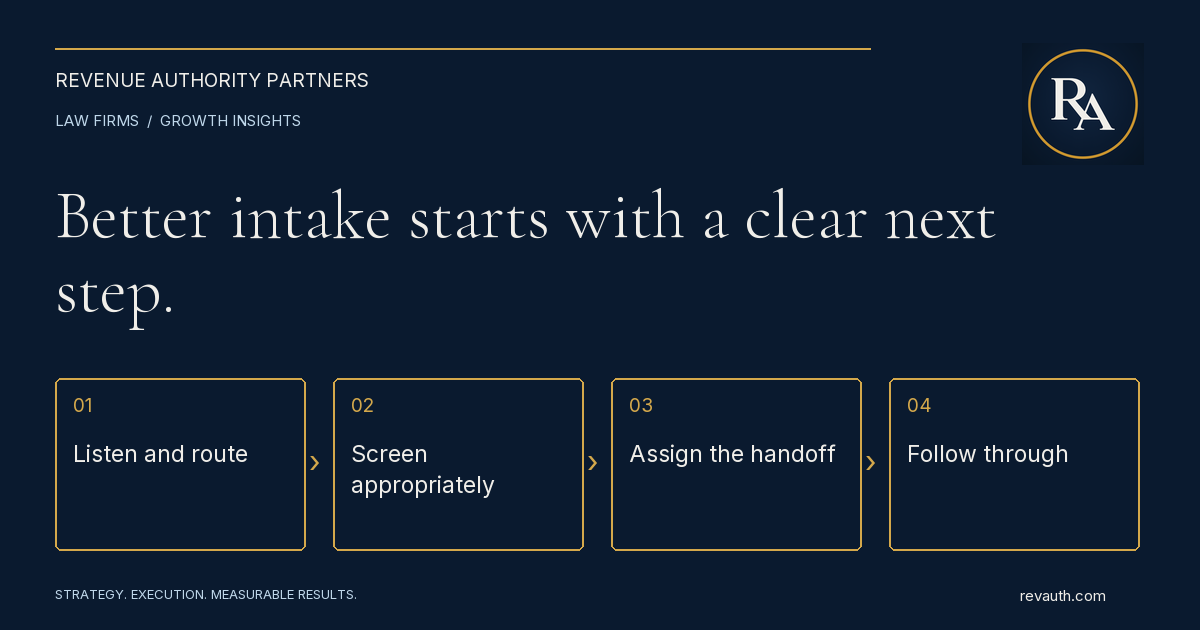
A personal injury intake script should help a person explain why they contacted the firm, give staff a consistent path through approved questions, and leave every inquiry with a responsible owner and next action. It should also keep legal judgments with attorneys. The strongest script is a working process: an opening, a limited initial screen, a conflict-check handoff, an attorney-review path, and clear follow-up. Start with the firm's actual services, staffing, and professional obligations. Then build the conversation around what the caller needs to understand next. A polished greeting cannot compensate for an unanswered callback or a record that nobody owns.
Define the purpose before writing the questions
Decide what the first conversation is meant to accomplish. For many firms, it is to collect enough approved information to route the inquiry, establish a reliable way to reconnect, identify an urgent review need, and arrange the next step. It is not a substitute for an attorney's assessment of liability, deadlines, representation, or potential recovery. Write the decision boundaries beside the script. Identify which staff members can schedule consultations, which issues require immediate attorney review, and who may communicate a decision about representation. Give staff an escalation contact for uncertainty. Do not make the caller wait while an employee guesses what the firm would accept. Have the responsible attorneys approve the complete flow, including website forms, answering-service instructions, voicemail, texts, and decline messages. A script should match the firm's jurisdiction-specific requirements and operating practices. The ABA Model Rules are a reference point, rather than a replacement for the rules that govern the firm.
Open with empathy and a clear explanation
An opening can be simple: “Thank you for contacting [firm]. My name is [name], and I help coordinate new inquiries. I can collect some initial information and explain our review process. Are you somewhere you can speak comfortably?” Adapt the wording to the firm's approved policies and the situation. If someone is distressed, slow the conversation down. Ask one question at a time and acknowledge what they are saying without offering conclusions about the case. Avoid turning empathy into a promise that the firm will take the matter or obtain a particular outcome. Explain what happens next before asking for a detailed account. Staff should use attorney-approved language about the initial review and the firm's engagement process. Do not promise that a generic disclaimer resolves confidentiality, privilege, or relationship questions. Those are legal issues for the firm's reviewers, not a script writer's shortcut.
Collect the minimum information needed for initial routing
Build an initial screen around approved fields. These may include the person's name, contact information, preferred communication channel, broad incident category, general location, incident date as reported, and the names needed for the firm's conflict process. Ask only what is appropriate at that point in the workflow. The ABA's comment on Model Rule 1.18 discusses limiting an initial consultation to information reasonably necessary to determine whether to undertake a matter. Its discussion also explains that duties can arise even when representation does not follow. Have counsel translate the applicable obligations into the firm's collection and access rules. Keep the initial record focused. An unrestricted “tell us everything” form can collect sensitive details before the firm knows how the inquiry should be handled. Use staged questions and an approved secure method for any later documents. Keep sensitive narratives out of advertising dashboards and general marketing reports.
Use a structured conversation after the approved screen
Once the firm's process allows a fuller discussion, organize questions in a predictable order. Staff might ask: “In a few sentences, what happened?” “Where and when did this occur?” “What is the best way to reach you?” and “Have you received any documents with a stated response date?” Use only questions the firm has approved for the relevant practice area. Record the person's account accurately and distinguish their words from staff observations. If a date is uncertain, mark it uncertain. If a document has not been reviewed, do not describe its contents as verified. The record should help the attorney understand what is known and what still needs clarification. Never turn a questionnaire into an automated legal decision. A date, location, injury description, or statement about another lawyer may require review. Staff should route those issues through the approved escalation process instead of calculating a deadline, assessing case value, or telling the person they have no claim.
Make the handoff specific and accountable
A handoff needs more than a status labeled “sent to attorney.” Assign a named owner or an actively monitored queue, a next action, and an internal review target. Record when the handoff occurred and how staff will learn whether it was accepted. Provide coverage when the usual reviewer is unavailable. A concise internal summary can contain the contact preference, incident category, reported dates, conflict-check status, outstanding questions, and reason for escalation. Keep access restricted to the people who need it. Do not circulate an entire sensitive narrative merely because several departments use the same CRM. The ABA's guidance on prospective-client conflicts describes the importance of reasonable measures around information received before retention. The practical operating lesson is to design the information path with the firm's attorneys. A sales pipeline template alone does not establish an appropriate legal intake process.
End every conversation with a clear next step
Before ending the call, summarize the agreed action: “Our next step is [approved action]. [Person or team] will contact you through [channel]. If you need to update your contact details, please use [approved method].” State only a response window the firm can actually support. Confirm the phone number or email and whether the person wants messages through that channel. Ask what message content is appropriate under the firm's policy. Shared devices and inboxes make a detailed reminder more sensitive than it may appear to the sender. Avoid saying “you're all set” if an attorney review, document request, or engagement step remains outstanding. Scheduling a consultation should not be described as acceptance of representation. Use counsel-approved wording to explain the status, and record the next task before closing the record.
Build follow-up around ownership and permission
Create a follow-up sequence with an owner, approved channels, reasonable spacing, and stop conditions. Counsel should review applicable communication requirements before the firm enables automated calls or texts. A submitted inquiry is not a reason to assume permission for every channel or an unrelated marketing campaign. A brief follow-up might say: “Hello [name], this is [staff member] with [firm], following up on your inquiry. Please contact us at [number] to discuss the next step.” Adapt the content to the communication preferences and privacy safeguards recorded by the firm. Track attempts separately from conversations. A message left, an unanswered call, a scheduled consultation, and an attorney-reviewed decision are different events. When someone asks for contact to stop, route and document that request promptly under the firm's policy. An automation should not continue simply because a pipeline stage was never updated.
Review quality and improve the process
Review a sample of records from first contact through the eventual outcome. Check whether staff asked approved questions, captured uncertainty, assigned ownership, completed the handoff, and communicated the next step accurately. Use permitted records and access controls; do not start recording calls without the firm's approved consent and retention process. Measure the steps that reveal operational problems: unanswered inquiries, overdue tasks, incomplete screens, consultations scheduled and attended, and matters accepted after attorney review. Keep definitions stable. A higher contact rate does not establish that the firm is receiving suitable matters or that every improvement came from the script. Connect the findings to training and systems. Repeated missing fields may indicate a confusing form. Repeated late callbacks may indicate a coverage problem. RevAuth helps firms connect intake and follow-up systems, CRM workflows, and performance reporting. Read our intake conversion guide for the broader process, or See if You Qualify for hands-on support.
Common questions
What should a personal injury intake script include?
Include an approved opening, limited initial screen, conflict-check process, attorney escalation path, contact preference, and a specific next action with an owner. Adapt the script to the firm and governing rules.
Should intake staff decide whether someone has a case?
Legal assessments and representation decisions belong with the appropriate attorneys. Staff should collect approved information, record uncertainty, and route questions through a defined review process.
How should a firm follow up after an inquiry?
Use approved channels, recorded preferences, assigned ownership, reasonable spacing, and stop conditions. Counsel should review communication requirements before automated calls or texts are enabled.
Share this guide
FacebookLinkedInPut the plan to work
Connect strategy with hands-on execution.
RevAuth helps law firms, medical providers, and established service businesses improve marketing, conversion, and the systems behind growth.
See if You QualifyRelated services
- Law Firm Intake & Patient Conversion Consulting
- CRM Implementation & Optimization
- Marketing Attribution & Performance Reporting
Continue reading
- Law Firm CRM vs. Legal Intake Software: What Does Your Firm Actually Need?
- How Much Should a Law Firm Spend on Marketing? A Budget Planning Guide